














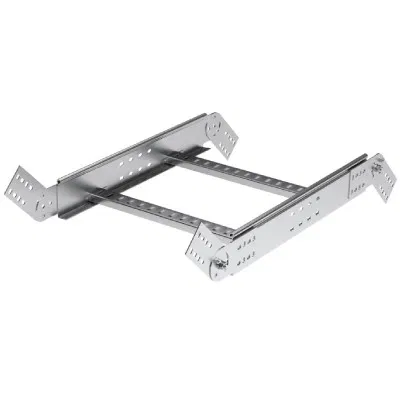
Types of cable management systems
Cable management systems provide organised cable routing, protection and ease of maintenance. The choice of type depends on the installation conditions, the number of cables, fire-safety requirements and budget.
Metal cable trays
Perforated trays are the most common type. The perforation provides cable ventilation and makes it easy to secure cables with ties.
- Use cases: server rooms, production facilities, commercial buildings
- Side rail height: 50–100 mm
- Width: 50–600 mm
- Finish: electro-galvanised, hot-dip galvanised (HDZ), powder-coated
Wire-mesh trays are lightweight and economical. Excellent ventilation and simple installation.
- Use cases: offices, shopping centres, data centres
- Advantages: lower weight, fast cable laying, lower cost
- Brands: DKC, BAKS, IEK
Solid (non-perforated) trays offer full protection of cables against mechanical damage.
- Use cases: routing along walls, in aggressive environments
- Note: heat dissipation must be calculated when the fill ratio is high
Plastic cable trunking
For surface routing in offices, apartments and shops. Attractive appearance, with a snap-on cover.
- Sizes: from 12×12 mm to 100×60 mm
- Material: flame-retardant PVC
- Colour: white (standard), wood-effect, grey
- Installation: with self-tapping screws or adhesive
Corrugated conduit (flexible conduit)
A protective sheath for single cables in concealed routing within walls, ceilings and floors.
- PVC conduit (grey) – for dry rooms, flame-retardant
- HDPE conduit (black) – for outdoor routing and routing underground, resistant to ultraviolet thanks to the carbon-black filler. PVC corrugated conduit or rigid PVC pipe is embedded in concrete
- Steel pipe – behind suspended ceilings and in the voids of structures made of combustible materials: clause 7.1.38 of the Russian electrical code PUE requires metal pipes with fire-containment capability or closed trunking. Flexible metal conduit as a rule does not provide such capability
Diameters: 16, 20, 25, 32, 40, 50 mm. Selected based on the number and diameter of the cables: wires and cables inside a conduit must lie freely, without tension. The numerical fill limit of 40% is set by clause 10.17 of SP 256.1325800.2016 for buildings with structures made of timber. For trunking, the PUE (clause 2.1.61) specifies 35% for solid trunking and 40% for trunking with openable covers.
When to use what
| Conditions | Recommendation |
|---|---|
| Many cables, server room | Wire-mesh trays |
| Production, shop floor | Perforated HDZ trays |
| Surface routing in an office | PVC cable trunking |
| Concealed in a wall (brick, concrete) | PVC conduit |
| Concealed in a wooden house | Steel pipe with fire-containment capability |
| Underground | Double-wall corrugated HDPE pipe |
The full range of DKC, BAKS and IEK cable management systems is in our catalogue.
View in catalog: Ladder-Type Cable Tray, Mounting Cable Trunking and Accessories, Cable Conduits, Cable Protection Sleeves.