














Planning
Before assembling the panel, a single-line diagram has to be drawn up, the number of circuits determined and the protective devices selected. A typical panel layout for a two-room apartment is as follows:
- Main circuit breaker 2P, 32–40 A
- Fire-protection RCD (residual current device) 2P, 63 A, 100–300 mA
- RCD 2P, 40 A, 30 mA – for the socket group (1–2 units)
- Circuit breakers 16 A, curve C – socket circuits (4–8 units)
- Circuit breakers 10 A, curve B – lighting (2–4 units)
- Circuit breaker 25 A – electric range / oven
- RCBO (combined RCD + circuit breaker) 16 A, 10 mA – washing machine, bathroom
- Voltage relay (optional, but recommended)
Choosing the Enclosure
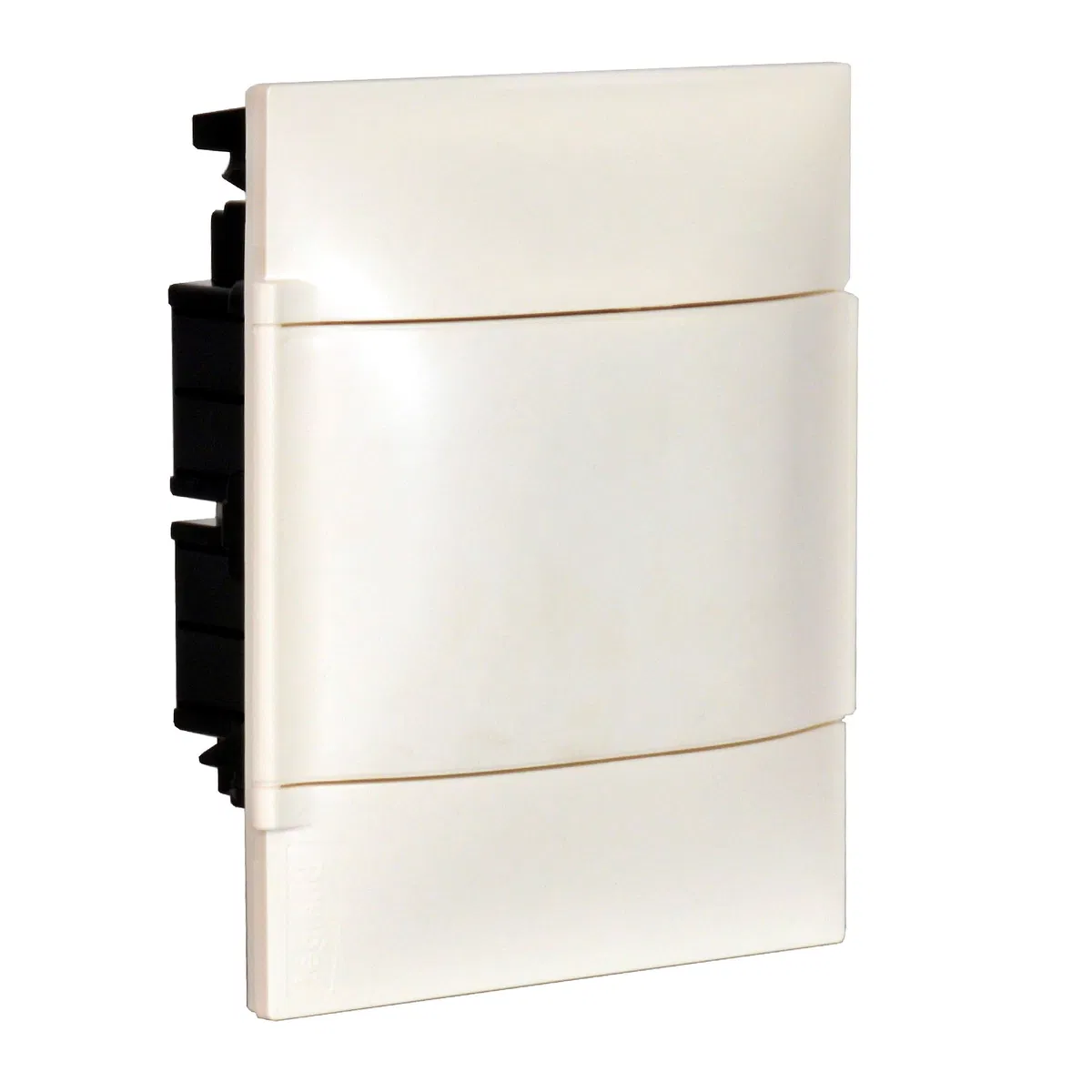
The enclosure is sized by the number of modules, with a 20–30% spare allowance. The standard module width is 18 mm (DIN rail). For an apartment an enclosure for 24–36 modules is usually enough; for a house, 48–72 modules.
- Surface-mounted – for drywall walls or where chasing is not possible
- Flush-mounted – for concrete and brick walls; looks neater
Installation Sequence
- Mounting the enclosure at a height convenient for servicing, usually 1.4–1.7 m from the floor (a recommendation for ease of servicing: the Russian Electrical Installation Code (PUE) sets no standardized mounting height for an apartment panel)
- Installing the DIN rails and the neutral/earth bus bars
- Placing the circuit breakers in the order: main breaker → meter (if inside the panel) → fire-protection RCD → group RCDs → circuit breakers for the individual circuits
- Connecting the busbar links (comb busbars) to distribute the phase from the RCDs to the circuit breakers
- Connecting the outgoing circuits – cables from the loads to the lower terminals of the circuit breakers
- Connecting the neutral conductors – to the neutral bus bars of the corresponding RCD groups
- Connecting the PE (earth) – all yellow-green conductors to the common PE bus bar
- Labeling – each circuit breaker is labeled (circuit number, purpose)
Important Rules
- Power is fed to the upper terminals of the circuit breakers, the outgoing circuits to the lower ones
- Solid-core cable is connected directly; stranded cable through insulated bootlace ferrules (NShVI)
- Each circuit breaker protects one circuit (do not combine circuits under a single breaker without calculation)
- Terminal tightening – to the torque given in the device data sheet, with a torque screwdriver (re-check 24 hours after installation)
Checks Before Switching On
- Visual inspection: all connections tightened, no pinched wires
- Insulation resistance test with a megohmmeter (no less than 0.5 MΩ)
- Testing the RCD trip with the "Test" button
- Stage-by-stage switch-on: main breaker → RCDs → circuits one at a time
All the components for assembling a panel are in the catalog. Need help with your selection? Get in touch with our engineers.
View in catalog: Panel and Cabinet Enclosures, Compact Distribution Board, Modular Circuit Breaker (MCB), Terminal Clamps.