













Illuminance standards
The illuminance level on working surfaces is governed by Russian building code SP 52.13330.2016 (the updated version of SNiP 23-05-95). The key requirements:
| Space | Required, lx | Note |
|---|---|---|
| Studies, work rooms, offices | 300 | Horizontal plane 0.8 m; visual-task grade B-1, UGR ≤ 21 (table L.1, row 1) |
| Computer rooms | 400 | 0.8 m on the desks; 200 lx on the screen, UGR ≤ 14 (table L.1, row 10) |
| Design and engineering offices | 500 | Horizontal plane 0.8 m (table L.1, row 2) |
| Conference and meeting halls | 200 | 0.8 m; cylindrical illuminance 75 lx, UGR ≤ 24 (table L.1, row 11) |
| Corridors | 50–100 | On the floor: main corridors 100 lx, the rest 50 lx, floor corridors of residential buildings 20 lx (table L.1, row 196) |
| Warehouses (general lighting) | 50–75 | Table L.2, rows 62–67, 71, 73 |
| Sorting and picking of goods | 300 | Horizontal plane 0.8 m (table L.2, row 70); receiving and dispatch areas – 200 lx |
| Racking and warehouse bins | 75 | Vertical plane (table L.2) |
| Production shop floor | 200–750 | Depends on the visual-task grade |
Types of luminaires
Panel lights (Armstrong 600x600) – the standard for offices with a suspended ceiling. Power 36–40 W, luminous flux 3600–4000 lm. One luminaire lights about 4–5 m².
Linear (surface-mounted/suspended) – for spaces without a suspended ceiling. Length 600–1200 mm, power 18–72 W. They provide uniform lighting when installed in rows.
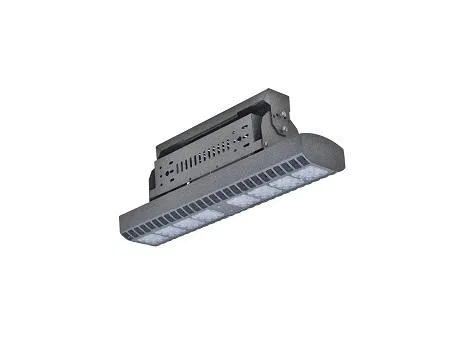
Industrial (High Bay) – for high ceilings (6–20 m): warehouses, production facilities, sports halls. Power 100–300 W, luminous flux up to 40,000 lm. The bell-shaped housing delivers directional light.
Downlights (recessed spots) – decorative and accent lighting: reception areas, meeting rooms, corridors.
Colour temperature
- 3000 K (warm white) – lounge areas, reception, conference rooms. Creates a cosy feel.
- 4000 K (neutral white) – the all-round choice for offices. Easy on the eyes, with good colour rendering.
- 5000–6500 K (cool white) – warehouses, production facilities, utility rooms. Maximum contrast.
For offices, 4000 K is the recommended choice – physiologically comfortable light for long hours of computer work.
Colour rendering index (CRI/Ra)
This shows how natural colours look under a given light source. For offices and most working spaces, sources with Ra of at least 80 are used; for spaces with higher colour-discrimination requirements, at least 90. The value required for a particular space is set by the lighting standards table of SP 52.13330.
Calculating the number of luminaires
A simplified formula: N = (E × S) / (F × η), where:
- E – required illuminance (lx)
- S – floor area of the space (m²)
- F – luminous flux of a single luminaire (lm)
- η – utilisation factor (0.4–0.6 for typical spaces)
Example: a 50 m² office requiring 400 lx, panels rated at 4000 lm, η = 0.5. N = (400 × 50) / (4000 × 0.5) = 10 luminaires. The formula does not account for the operational decline in luminous flux. SP 52.13330.2016 standardises not a safety factor but a maintenance factor MF (table 4.3), related to it as MF = 1/Kz. For public and residential spaces under normal conditions MF = 0.71, and for luminaires with LEDs note 4 to the table prescribes multiplying it by 1.05: 0.71 × 1.05 = 0.75, which corresponds to Kz ≈ 1.34. The calculated number of luminaires is increased by this amount.
Energy efficiency
LED luminaires deliver 100–150 lm/W against 60–90 lm/W for fluorescent fixtures, so at the same luminous flux they consume roughly 1.5–2 times less. A gain of 5–7 times applies to a comparison with incandescent lamps. Service life is 50,000 hours, which is 11.4 years at 12 hours of operation per day.
LED lighting for any application is available in our catalogue.
View in catalog: Ceiling and wall luminaires, LED Lamps, Floodlights and Directional Luminaires, High-bay and tunnel luminaires.