














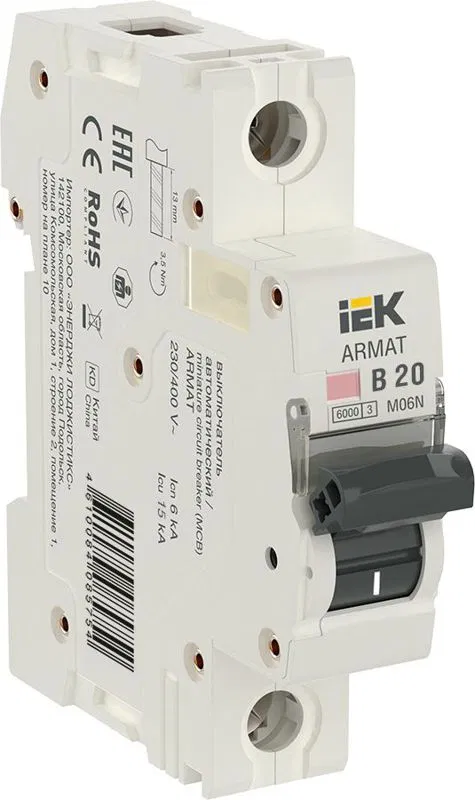
What to compare in miniature circuit breakers
Requirements for circuit breakers for household and similar installations are set by GOST IEC 60898-1-2020, in force since 1 March 2021 in place of GOST R 50345-2010. The standard defines the series of rated short-circuit capacities: 1500, 3000, 4500, 6000 and 10,000 A, plus a preferred value of 20,000 A. Instantaneous tripping ranges are tied to multiples of the rated current: B 3–5 In, C 5–10 In, D 10–20 In.
A practical rule follows from this: two breakers of different makes with the same rating, tripping characteristic and breaking capacity protect the circuit identically. The difference between brands lies elsewhere: how deep the range goes in Icn, whether direct-current versions and special characteristics exist, the accessory list, and compatibility of busbar combs and enclosures.
ABB: S200, SH200L, Basic M
A Swedish-Swiss corporation. The modular range is split by breaking capacity rather than by consumer segment, so residential and industrial versions sit side by side in one catalogue.
- S200 (S201, S202, S203): the core professional series, Icn 6 kA; the S200M version offers 10 kA
- SH200 / SH200L: residential series, 4.5 kA
- Basic M (BMS41x): simplified series at 4.5 kA with characteristic C
- Characteristics: besides B, C and D, the S200 family includes K and Z versions for control circuits and low-current equipment
Legrand: RX3, TX3, DX3
A French group whose strength is switchboard assembly: busbar combs, XL3 enclosures, auxiliary contacts and trip units form a complete system.
- RX3: range for residential installations, 4.5 kA
- TX3: mid segment, 6 kA at 400 V, and 10 kA at 230 V for the 2P–4P versions
- DX3: professional range, DX3 6000 and DX3 10000 versions, breaking capacity up to 16 kA depending on version and voltage
- DPX3: moulded-case power circuit breakers for incoming assemblies
Schneider Electric: Acti9 iC60, EasyPact, Resi9
A separate brand with its own part-number range. In the catalogue these are standalone items that do not overlap with Systeme Electric or DEKraft, even though all three brands are historically linked.
- Acti9 iC60: the main modular series, iC60N at 6 kA, iC60H at 10 kA, iC60L with enhanced current limiting
- Reflex iC60: versions with integrated control and the Ti24 interface
- EasyPact: a range for standard distribution tasks
- Resi9: equipment for residential boards
- Part numbers: Acti9 numbers start with A9, which sets them apart from the C9 and S9 prefixes used by Systeme Electric
Systeme Electric: City9 Set, Systeme9, SystemePact
The company was formed in 2022 on the basis of Schneider Electric's assets in Russia and Belarus and develops its own product lines under its own name. The modular part follows the Acti9 logic in terms of breaking-capacity classes, but the part numbers, catalogues and series designations are its own.
- City9 Set: series for residential boards; 4.5 kA versions at 230 V and 6 kA versions at 400 V are produced in parallel, characteristics B and C, ratings up to 63 A, energy limiting class 3
- Systeme9: the main modular series in two classes, 6 kA and 10 kA, with characteristics B, C and D
- SystemePact MCP: moulded-case circuit breakers; SystemePact ACB covers air circuit breakers for incoming assemblies
- City9 Box: enclosures matched to the same range
DEKraft: VA-101, VA-103, VA-105
The brand belongs to the Systeme Electric group, but its range is entirely its own: series designations, part numbers and accessories do not coincide with City9 Set or Systeme9. It is positioned as high-volume equipment for residential and commercial construction.
- VA-101: base series, 4.5 kA
- VA-103 and VA-103M: 6 kA for the 1P–4P versions and 4.5 kA for 1P+N, ratings up to 63 A
- VA-105: reinforced series at 10 kA, with a VA-105 DC version for direct-current circuits
- Related products: DIF-101 and DIF-103 residual current breakers with overcurrent protection, VR-101 switch-disconnectors, moulded-case breakers with an adjustable thermal release
IEK: VA47-29, VA47-60M, VA47-100, ARMAT
The widest range among the makes covered here: from a high-volume residential series up to air circuit breakers rated 6300 A in the ARMAT family.
- VA47-29: high-volume series, 4.5 kA, ratings 0.5–63 A
- VA47-60M: 6 kA, part of the KARAT range; the VA47-60MA version without a thermal release is available for control circuits
- VA47-100: semi-industrial series, 10 kA, ratings up to 100 A
- ARMAT: professional family; modular M06N at 6 kA, M10N and M10H at 10 kA, including versions with characteristic K and direct-current variants
EKF: VA 47-63, VA 47-100, VA 47-125, Averes
The range is built around the PROxima series, with the premium Averes family added on top.
- VA 47-63: 4.5 kA, ratings up to 63 A, with a VA 47-63 DC version
- VA 47-63N: reinforced version at 6 kA, characteristics B and C
- VA 47-100 and VA 47-125: 10 kA and 15 kA, ratings up to 125 A; the 47-100M modification is available without a thermal release
- Averes AV-6 and AV-10: 6 kA and 10 kA, including direct-current versions
TDM ELECTRIC: VA47-29, VA47-60, VA47-100
The make occupies the niche of straightforward solutions for standard electrical installation; the range is compact and has no premium segment.
- VA47-29: 4.5 kA, ratings up to 63 A
- VA47-60: 6 kA, with a VA47-60DC version for direct-current circuits
- VA47-100: 10 kA, characteristics C and D, ratings up to 100 A
Summary table of ranges
| Brand | Modular series and Icn | Characteristics | Ratings | Typical use |
|---|---|---|---|---|
| ABB | SH200L and Basic M 4.5 kA; S200 6 kA; S200M 10 kA | B, C, D, plus K and Z | up to 63 A | projects specified around European part numbers |
| Legrand | RX3 4.5 kA; TX3 6 kA; DX3 up to 16 kA | B, C, D | up to 63 A | boards built with the brand's own combs and XL3 enclosures |
| Schneider Electric | iC60N 6 kA; iC60H 10 kA; iC60L with current limiting | B, C, D, plus K and Z | up to 63 A | commercial and infrastructure facilities |
| Systeme Electric | City9 Set 4.5 and 6 kA; Systeme9 6 and 10 kA | B, C, D | up to 63 A | residential and commercial boards, incoming assemblies on SystemePact |
| DEKraft | VA-101 4.5 kA; VA-103 6 kA; VA-105 10 kA | B, C, D | up to 63 A | high-volume residential and commercial construction |
| IEK | VA47-29 4.5 kA; VA47-60M 6 kA; VA47-100 10 kA; ARMAT 6 and 10 kA | B, C, D, and K in ARMAT | up to 100 A | from a flat's consumer unit to distribution assemblies |
| EKF | VA 47-63 4.5 kA; VA 47-63N 6 kA; VA 47-100 10 kA; VA 47-125 15 kA | B, C, D | up to 125 A | residential boards and direct-current circuits |
| TDM ELECTRIC | VA47-29 4.5 kA; VA47-60 6 kA; VA47-100 10 kA | B, C, D | up to 100 A | standard electrical installation |
ABB or Schneider Electric
Both makes cover the same segment, and with equal rating, characteristic and Icn the protective behaviour of the breakers is the same. The differences begin outside the protective function.
- Range structure: ABB splits the classes across series (SH200L and Basic M at 4.5 kA, S200 at 6 kA, S200M at 10 kA), whereas Schneider Electric assigns the same role to versions of a single Acti9 iC60 series (iC60N at 6 kA, iC60H at 10 kA)
- Special versions: Schneider Electric offers Reflex iC60 with integrated control and the Ti24 interface; ABB focuses on a broad set of characteristics, including K and Z
- Compatibility: busbar combs, auxiliary contacts and trip units are not interchangeable between the brands, so continuing with the same make in an existing board costs less than a mixed set
The direct answer: for a 6 kA board the choice is equivalent, and what decides it is compatibility with the installed equipment and the availability of the specific version. For distribution boards that need one consistent line from modular to power devices with the same accessory logic, Schneider Electric offers a tighter link between iC60 and EasyPact; ABB wins where the design calls for characteristics K or Z.
ABB or IEK
Comparable pairs exist across the whole scale: SH200L and VA47-29 at 4.5 kA, S200 and VA47-60M at 6 kA, S200M and VA47-100 or ARMAT M10N at 10 kA. With equal parameters there is no difference in how the circuit is protected.
The differences show up in two places. The first concerns the upper limit of ratings: the IEK modular series VA47-100 reaches 100 A, while the ABB modular range stops at 63 A and continues with moulded-case devices. The second relates to how far the range goes upwards: IEK's ARMAT continues into air circuit breakers, which allows an entire facility to be built on one make. In ABB's favour are the K and Z characteristics and a longer record of use in design documentation.
ABB or Legrand
ABB S200M and Legrand DX3 sit at the same level of breaking capacity, TX3 matches S200 at 6 kA, and RX3 and SH200L cover the 4.5 kA base level. Legrand builds a complete switchboard system around its breakers: XL3 enclosures, busbar combs, residual current modules. ABB is stronger in the variety of characteristics and modifications within a single series. If the board is assembled entirely from one system, Legrand saves assembly time; if an exact match with the tripping type stated in the design is required, ABB is more often the fit.
Legrand or Schneider Electric
TX3 and iC60N are comparable in the 6 kA class, DX3 and iC60H overlap at 10 kA. The approaches differ: Schneider Electric produces versions with extended control and diagnostics within Acti9, while Legrand bets on board assembly speed and a uniform accessory mechanism. For residential and small commercial boards the two ranges are interchangeable in terms of characteristics, and the choice comes down to whose enclosures and busbars are already used on site.
IEK or EKF
The closest neighbours in positioning. VA47-29 and VA 47-63 occupy the same 4.5 kA niche, VA47-60M and VA 47-63N share the 6 kA class, and VA47-100 and VA 47-100 stand at 10 kA.
- By ratings: EKF reaches higher thanks to VA 47-125 at 15 kA with ratings up to 125 A, whereas the IEK modular range ends at 100 A
- By direct current: EKF offers DC versions already in the high-volume VA 47-63 DC series and in Averes; at IEK this niche is covered by ARMAT M06N-DC and M10N-DC
- By coverage of a facility: IEK takes the range up to ARMAT air circuit breakers, which matters when a whole facility is built on one make
Systeme Electric or DEKraft
The makes belong to one group, but they are not variants of the same product. DEKraft splits three classes across separate VA-101, VA-103 and VA-105 series in steps of 4.5, 6 and 10 kA, and offers the VA-105 DC version. At Systeme Electric the residential segment is covered by City9 Set, while the main load is carried by Systeme9 in the 6 and 10 kA classes with characteristic D, which the modular DEKraft series do not have. Accessories and part numbers differ between the ranges, so a replacement is selected by parameters rather than by group membership.
IEK or Legrand
TX3 and VA47-60M are comparable in the 6 kA class, and DX3 stands above VA47-100 in breaking capacity. Legrand provides a ready switchboard system and a more compact range, while IEK has a wider spread of series and modular ratings up to 100 A. For a standard flat's consumer unit both makes cover the task completely.
Selecting an equivalent by parameters
A replacement is selected not by brand but by matching parameters: rated current, tripping characteristic, rated short-circuit capacity, number of poles, width in DIN modules and connection type. When these values match, a series from any of the makes fills the same position in the design.
| Icn class | Equivalent series |
|---|---|
| 4.5 kA | ABB SH200L and Basic M, Legrand RX3, Systeme Electric City9 Set 230 V, DEKraft VA-101, IEK VA47-29, EKF VA 47-63, TDM VA47-29 |
| 6 kA | ABB S200, Schneider Electric iC60N, Legrand TX3, Systeme Electric Systeme9 6 kA and City9 Set 400 V, DEKraft VA-103, IEK VA47-60M and ARMAT M06N, EKF VA 47-63N and Averes AV-6, TDM VA47-60 |
| 10 kA | ABB S200M, Schneider Electric iC60H, Legrand DX3, Systeme Electric Systeme9 10 kA, DEKraft VA-105, IEK VA47-100 and ARMAT M10N, EKF VA 47-100 and Averes AV-10, TDM VA47-100 |
The mechanical side is checked separately: a busbar comb, an auxiliary contact and a shunt trip are taken only from the same make's list, and often from the same series. This is the step at which a board with mixed components most often falls apart.
Choosing for the task
- A flat's consumer unit with an incoming breaker up to 40 A: VA47-29, VA 47-63, VA-101, City9 Set or TDM VA47-29 in the 4.5 kA class
- A board for a private house or a small office: the 6 kA class, where Systeme9, VA-103, VA47-60M, VA 47-63N, TX3, S200 and iC60N are comparable
- A site with a high short-circuit current at the incomer: 10 kA and above, meaning ARMAT M10N, VA47-100, VA 47-100, VA-105, DX3, S200M, iC60H
- Direct-current circuits: VA-105 DC, VA 47-63 DC, Averes DC, ARMAT M06N-DC, TDM VA47-60DC
- Ratings above 100 A in a modular format: EKF VA 47-125, beyond which the range moves to moulded-case devices such as SystemePact, DPX3 or ARMAT
One more practical difference follows from the assortment: for IEK, EKF, Legrand and DEKraft a current price is set on most active catalogue items and stock is spread across the whole range, while for ABB and Schneider Electric, out of tens of thousands of catalogue positions, only individual versions carry a price and stock. When selecting a replacement this affects lead times more than any difference in characteristics.
All the brands listed are present in the catalogue.
View in catalog: Modular Circuit Breaker (MCB), Residual Current Circuit Breaker (RCCB), Residual Current Device (RCD), Power Circuit Breaker (ACB/MCCB).