














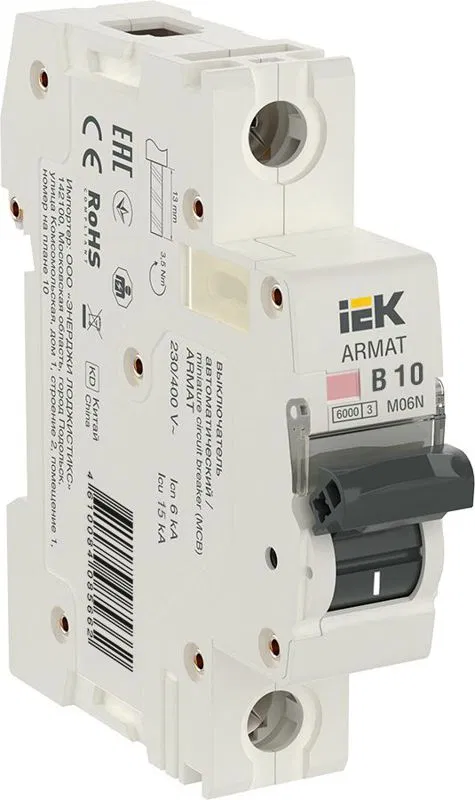
Why You Need a Circuit Breaker
A circuit breaker is the main device for protecting electrical circuits against overload and short circuit. The right choice of breaker ensures the safety of the electrical installation and prevents damage to the wiring and equipment.
Rated Current: How to Determine It
The rated current of the breaker must match the cable cross-section and the permissible load of the circuit. The basic rule: the breaker protects the cable, not the loads.
| Cable cross-section, mm² | Permissible current, A | Recommended breaker |
|---|---|---|
| 1.5 | 23 | 10 A or 16 A |
| 2.5 | 30 | 16 A or 25 A |
| 4.0 | 41 | 25 A or 32 A |
| 6.0 | 50 | 32 A or 40 A |
| 10.0 | 80 | 50 A or 63 A |
The permissible currents are given for single copper conductors with PVC insulation laid in open air per PUE-7, table 1.3.4. When laid in a conduit or concealed, the permissible current is reduced (for example, for 1.5 mm² in a conduit – 19 A, for 2.5 mm² – 25 A), so the breaker rating is chosen according to the actual laying conditions.
Tripping Curve: B, C or D
The curve determines the short-term current overshoot at which the breaker trips instantaneously:
- Curve B (3–5 In) – for circuits without inrush currents: lighting, socket groups in apartments. The most sensitive, with maximum protection of the wiring.
- Curve C (5–10 In) – universal, for circuits with moderate inrush currents: air conditioners, pumps, mixed loads. The most common choice.
- Curve D (10–20 In) – for electric motors, transformers and other equipment with high inrush currents.
For an apartment or house, curve C is suitable in most cases. Curve B is worth considering for lighting and socket circuits if there are no powerful loads with inrush currents.
Characteristics A, K and Z apply to industrial circuit breakers per GOST R 50030.2 (IEC 60947-2) rather than to modular domestic ones: A protects semiconductor circuits and instrument transformers, Z protects electronics, K protects motors with high inrush currents. They are not used in apartment panels.
Breaking Capacity
This parameter indicates the maximum short-circuit current that the breaker can safely interrupt:
- 4.5 kA – the minimum level, acceptable for private houses with a remote transformer
- 6 kA – the most common value in the residential sector
- 10 kA – for commercial facilities and premises near a transformer substation
The required value is determined by the calculated short-circuit current at the point where the device is installed (PUE, chapter 1.4), and not by the type of facility. The standard series per clause 5.3.4.1 of GOST IEC 60898-1-2020: 1500, 3000, 4500, 6000 and 10,000 A; above 10,000 A the preferred value is 20,000 A (clause 5.3.4.2).
Number of Poles
- 1P (single-pole) – protects the phase conductor. Used in single-phase networks for individual circuits.
- 2P (double-pole) – switches the phase and neutral simultaneously. Used as the main breaker in a single-phase network.
- 3P (three-pole) – for three-phase loads (electric motors, three-phase ranges).
- 4P (four-pole) – the main breaker in a three-phase network; switches all three phases and the neutral.
Comparison of Popular Brands
| Parameter | IEK ВА47-29 | ABB S200 | Schneider iC60N | Legrand TX3 |
|---|---|---|---|---|
| Breaking capacity (Icn) | 4.5 kA | 6 kA (S200M – 10 kA) | 6 kA | 6 kA at 400 V; 10 kA for 2P–4P at 230 V |
| Current-limiting class | Not published by the manufacturer | 3 | 3 | 3 (for B and C up to 40 A) |
| Price segment | Budget | Premium | Premium | Mid-range |
Selection Recommendations
- For an apartment: 16 A curve C breakers for sockets, 10 A for lighting, a 32–40 A main breaker
- For a private house: curve B or C, breaking capacity from 6 kA
- For commercial facilities: ABB or Schneider Electric, breaking capacity 10 kA
- Budget option: IEK ВА47-29 or EKF – the optimal price/quality ratio
The full range of circuit breakers is available in our catalog. To select equipment for your project, get in touch with us.
View in catalog: Modular Circuit Breaker (MCB), Residual Current Circuit Breaker (RCCB), Residual Current Device (RCD), Power Circuit Breaker (ACB/MCCB).