














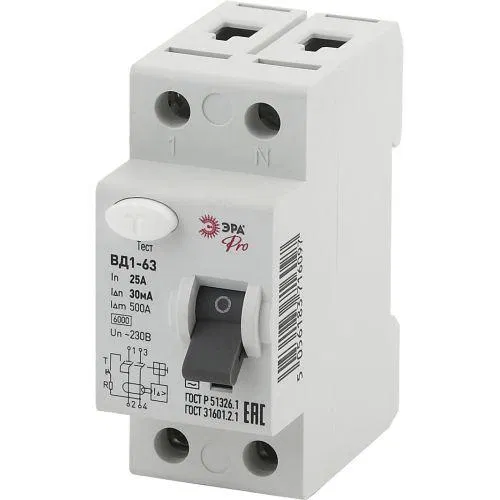
What an RCD Is
An RCD (residual current device, УЗО) is a device that monitors the difference in current between the phase and neutral conductors. In the event of a current leakage to earth (for example, when a person touches a bare wire or the insulation is damaged), the RCD instantly disconnects the circuit.
Important: an RCD does not protect against overload or short circuit. That is why a circuit breaker must always be installed ahead of the RCD.
What an RCBO (AVDT) Is
A residual-current circuit breaker with overcurrent protection (RCBO, AVDT) is a combined device that integrates the functions of a circuit breaker and an RCD in a single housing. It protects against overload, short circuit and current leakage all at once.
Comparison of Characteristics
| Parameter | RCD + circuit breaker | RCBO (AVDT) |
|---|---|---|
| Overload protection | Circuit breaker | Built in |
| Short-circuit protection | Circuit breaker | Built in |
| Leakage protection | RCD | Built in |
| Space in the panel | 4 modules (2+2) | 2 modules |
| Cost | Lower overall | Higher |
| Diagnostics on tripping | You can see what tripped | Cause not always clear |
| Replacement on failure | One device is replaced | The whole unit is replaced |
Leakage Current: 10 mA or 30 mA
- 10 mA – for wet rooms (bathroom, sauna) and dedicated circuits for a washing/dishwashing machine
- 30 mA – the standard rating for socket groups and general protection per the PUE (clause 7.1.79)
- 100–300 mA – a fire-protection RCD at the incomer, protecting against fire caused by leakage
RCD Type: AC or A
- Type AC – responds to sinusoidal leakage current. The most common and inexpensive.
- Type A – responds to both sinusoidal and pulsating DC leakage current. Recommended for circuits with washing machines, frequency converters and switch-mode power supplies.
Besides types AC and A, type F is produced for single-phase circuits with frequency converters (washing machines with an inverter drive, air conditioners), and type B, which also responds to smooth DC leakage current and is required for electric-vehicle charging stations, photovoltaic installations and variable-frequency drives. Separately there is a selective version with a time delay, marked with the letter S: it is placed upstream at the incomer so that in the event of a leakage on a group circuit the group device trips first rather than the incoming one.
When to Install Which
RCD + circuit breaker:
- When a single RCD protects several circuits (cost saving)
- When diagnostics matter: the toggle of the breaker or the RCD shows exactly what tripped
- In panels with a large number of circuits
RCBO:
- When there is little space in the panel
- For individual critical circuits (washing machine, water heater)
- During a retrofit, when protection needs to be added without replacing the panel
Regulatory Requirements
RCDs in residential buildings are governed by clauses 7.1.71–7.1.88 of the PUE. For group circuits of socket outlets, clause 7.1.79 prescribes RCDs with a setting of no more than 30 mA, while clause 7.1.82 makes them directly mandatory for socket circuits outdoors and in premises that are particularly hazardous or of increased hazard. At the incomer, installing a fire-protection RCD of 100–300 mA is recommended.
You can select RCDs and RCBOs in our catalog.
View in catalog: Residual Current Device (RCD), Residual Current Circuit Breaker (RCCB), Modular Residual Current Devices (RCD), Modular Circuit Breaker (MCB).