














Regulatory framework
The temporary power supply of construction sites is governed by:
- PUE, 7th edition (Chapter 7.1 – electrical installations of buildings; Chapter 6.1 – electric lighting)
- SNiP 12-03-2001 "Occupational safety in construction"
- GOST R 50571.7.704-2013 (requirements for electrical installations on construction sites)
- SP 48.13330.2019 "Organization of construction"
Power supply intake
The temporary connection is arranged through the power supply utility. At the intake point an input distribution unit (VRU) is installed, equipped with:
- An input switch-disconnector or circuit breaker
- An electricity meter
- A residual current device (RCD) at the intake
Distribution panels
Two types of panels are used on a construction site:
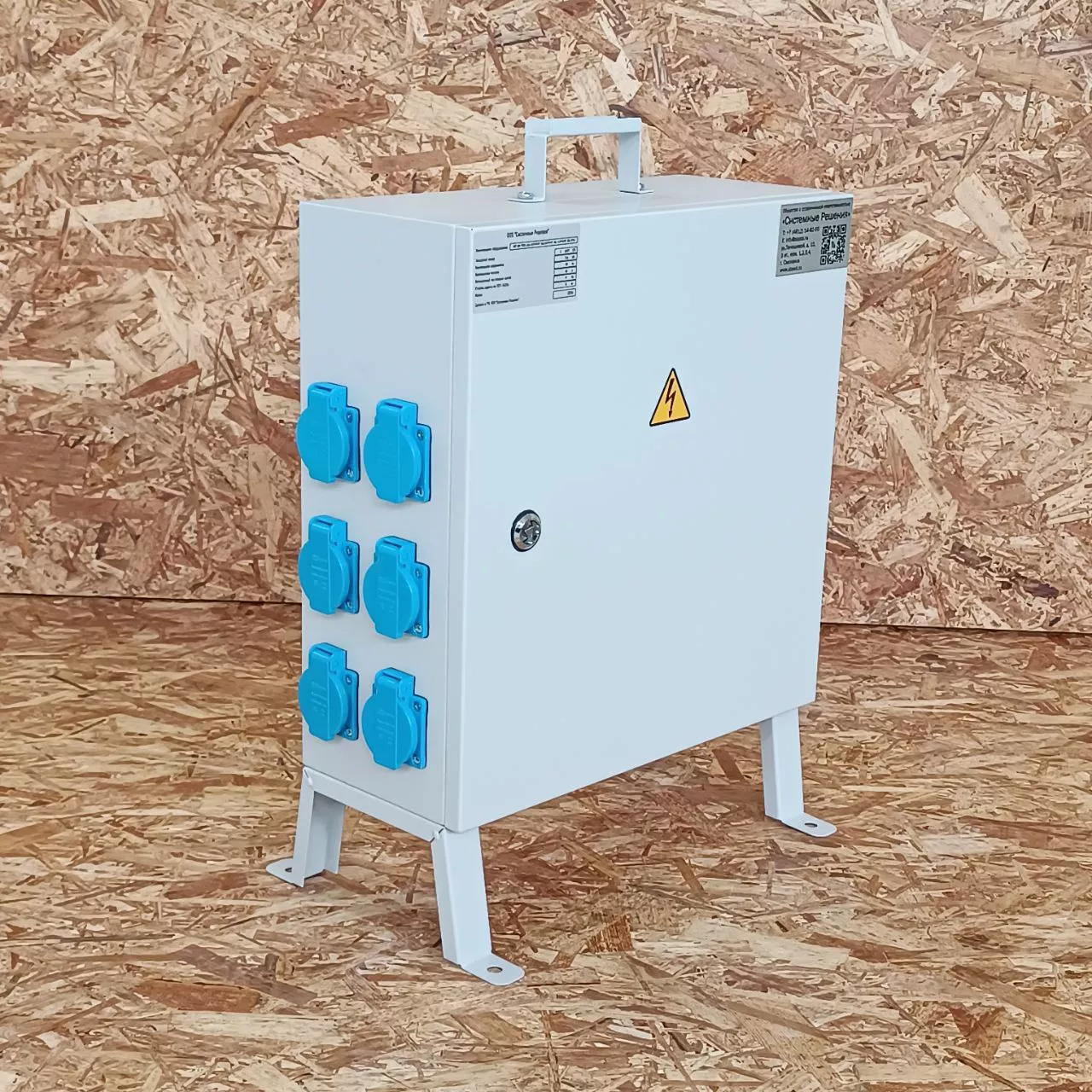
VRU (input distribution unit) – the site's main panel. Degree of protection no lower than IP44.
Distribution boards (RP) – intermediate boards for connecting a group of loads. Installed in the work area.
All panels must be fitted with:
- Circuit breakers on each outgoing line
- RCDs with a 30 mA leakage current on all socket groups (PUE clauses 7.1.79, 7.1.82)
- CEE-type industrial sockets with degree of protection IP44
- A voltage-presence indicator
Mandatory protective devices
- Circuit breakers – on each line, characteristic C or D
- 30 mA RCD – mandatory for all socket groups and portable tools
- 10 mA RCD – for especially hazardous conditions (damp premises, work in excavation pits)
- Circuit breaker at the intake – for overall protection and the ability to shut everything off completely
Earthing
A TN-S or TN-C-S earthing system is mandatory on a construction site. Requirements:
- Repeated earthing of the PEN conductor at the intake – no more than 30 Ω (PUE clause 1.7.103); 4 Ω applies to the earthing arrangement of the source neutral (clause 1.7.101)
- All metal equipment enclosures earthed
- Scaffolding and fencing connected to the earthing loop
- Equipotential bonding conductors – at least 6 mm² in copper or 16 mm² in aluminium; the cross-section of the PE protective conductor is selected per PUE table 1.7.5
Cable runs
- For fixed runs: VVGng-LS cable in protective conduits or trays
- For temporary connections: KG cable (flexible) with rubber insulation
- Outdoor temporary wiring on supports: no lower than 2.5 m above workplaces, 3.5 m above walkways and 6 m above driveways
- Across driveways: in conduits buried to 0.8 m, or on supports at a height of at least 6 m
Portable electrical equipment
- Class II power tools (double insulation) or Class III (42 V) for damp premises
- Extension cords – KG cable 3×1.5 mm² or 3×2.5 mm². For extension cords on cable reels the limiting length is set by GOST 31223-2012: 60 m for a 1.5 mm² cross-section. The length is verified by a voltage-drop calculation: 1.5 mm² at a current of 16 A over 60 m gives about 10% loss
- Portable luminaires – voltage no higher than 50 V (PUE clause 6.1.17)
Minimum kit for a construction site
- IP54 input panel with a meter, switch-disconnector and RCD
- 1–2 IP44 distribution boards with circuit breakers and 30 mA RCDs
- VVGng-LS or KG cable for wiring
- Earthing kit (rods, strip, clamps)
- CEE IP44 sockets for connecting equipment
All the electrical equipment you need for a construction site is in our catalogue. We will advise you on selecting a kit.
View in catalog: Construction Site Distribution Board, Complete Switchboard Equipment, Modular Circuit Breaker (MCB), Cables and Wires for Flexible (Non-Fixed) Installation.